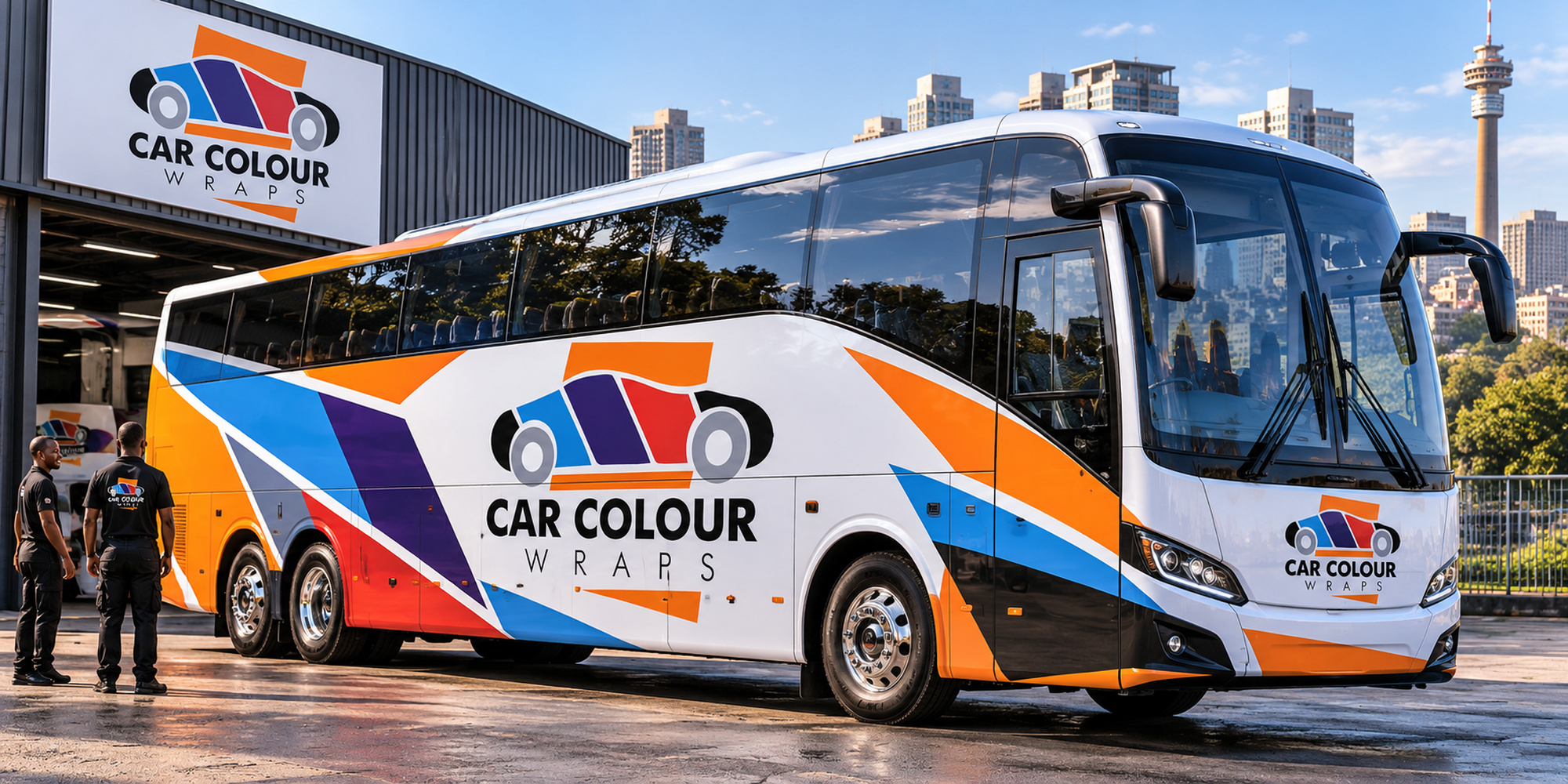
A bus is one of the largest moving advertising surfaces on the road, but wrapping one is a project in its own right: working at height, dealing with rivets and panel joins, planning around large windows and fitting the work into route schedules.
This page is for bus and coach operators, schools, companies and advertisers who want buses branded or wrapped. Installations take place at our Rivonia workshop in Sandton.
About this service
Height is the first practical challenge. Upper panels and the roof edge need safe, stable access so film can be applied evenly. Bus bodies are often made of riveted or bonded panels with visible joins, and film must be worked around rivet heads and into seams so it does not tent or lift. Access hatches, engine bay doors and luggage lockers need cuts so they can still open.
Windows take up much of a bus’s sides. Perforated graphics can be applied to side and rear windows where legally appropriate, taking passenger visibility into account; we do not cover the front windscreen or driver’s side windows. Destination displays, lights, cameras and emergency exits must stay clear and readable.
Because buses run to schedules, planning matters. We have the capacity to wrap up to 50 vehicles per week and guarded, covered storage for up to 200 vehicles, which helps when several buses need to be done in sequence. Ask us whether on-site installation is possible for your fleet project. Results depend on panel condition, material, installation and care.
Suitable vehicles and common uses
- City and commuter buses
- Coaches and tour buses
- School buses
- Corporate staff buses
- Buses carrying third-party advertising
- Operators rebranding a fleet
Available options
- Full printed bus wraps
- Partial wraps on sides, rear or lower panels
- Perforated window graphics on side and rear windows, where legally appropriate
- Cut vinyl lettering, fleet numbers and contact details
- Reflective elements that do not imitate emergency-vehicle markings
- Design and layout tailored to your bus body
Options depend on the material available at the time of your project and on your vehicle. We confirm exactly what is possible in your quotation.
Why choose it
- Very large surfaces give advertising high visibility
- Advertising can be changed when campaigns end
- Panels can be replaced individually after damage
- Fleet capacity and secure storage support scheduled rollouts
- Original paint stays underneath
Things to consider
- Rivets, panel joins and access hatches add installation time
- Window graphics must allow for passenger visibility and regulations
- Destination displays, lights, cameras and emergency exits must stay clear
- Very old, faded or repaired panels may not bond or remove predictably
- Buses need to be available at the workshop for installation
Preparation and installation process
- Survey and schedule. We record the bus model and body layout and agree a schedule that fits your routes.
- Design and proof. Artwork is laid out around windows, hatches and displays, and approved by you before printing.
- Print and prepare. Panels are printed while each bus is washed, degreased and inspected.
- Installation at height. Film is applied using safe access equipment, worked around rivets, seams, hatches and window edges.
- Checks and release. We check that hatches open, exits and displays are clear and edges are sealed before the bus returns to service.
What affects the price
- Bus length, height and body type
- Full, partial or window-only coverage
- Number of rivets, hatches and panel joins
- Design complexity and campaign variants
- Number of buses and scheduling requirements
- Panel condition and preparation
Every vehicle is different, so we quote each job individually. Your final quotation depends on the vehicle, the material, how much of the vehicle is covered, any artwork, and the condition of the paint once we have assessed it.
Turnaround
Timing depends on the size of the bus, coverage, design approval, printing and how many buses are involved. We plan installations around your route schedules. Timing is confirmed with your quote after we have surveyed the buses and agreed the design.
Care and maintenance
- Avoid brush-type bus washes where possible, or check they are suitable for wrapped vehicles
- Keep pressure washer jets away from edges, seams and rivets
- Keep window graphics clean so they stay see-through from inside
- Report damage early so panels can be replaced
- Avoid harsh chemical degreasers on printed film
- Plan inspections when buses are in for routine maintenance
Frequently asked questions
Can you wrap several buses without disrupting our routes?
We plan a schedule with you. Our capacity to wrap up to 50 vehicles per week and guarded, covered storage for up to 200 vehicles help with rotating buses through the workshop.
Can you cover the bus windows?
Side and rear windows can take perforated graphics where legally appropriate. We do not cover the front windscreen or driveru2019s side windows, and emergency exits remain clearly marked.
Can you install at our depot?
Installations take place at our Rivonia workshop. Ask us whether on-site installation is possible for your fleet project.
What happens when an advertising campaign ends?
The old wrap can be removed and a new one applied. How cleanly it removes depends on the age and quality of the film and the paint underneath.
Areas we serve
Customers bring their vehicles to our workshop in Rivonia, Sandton from across Gauteng. All installations take place at the workshop.