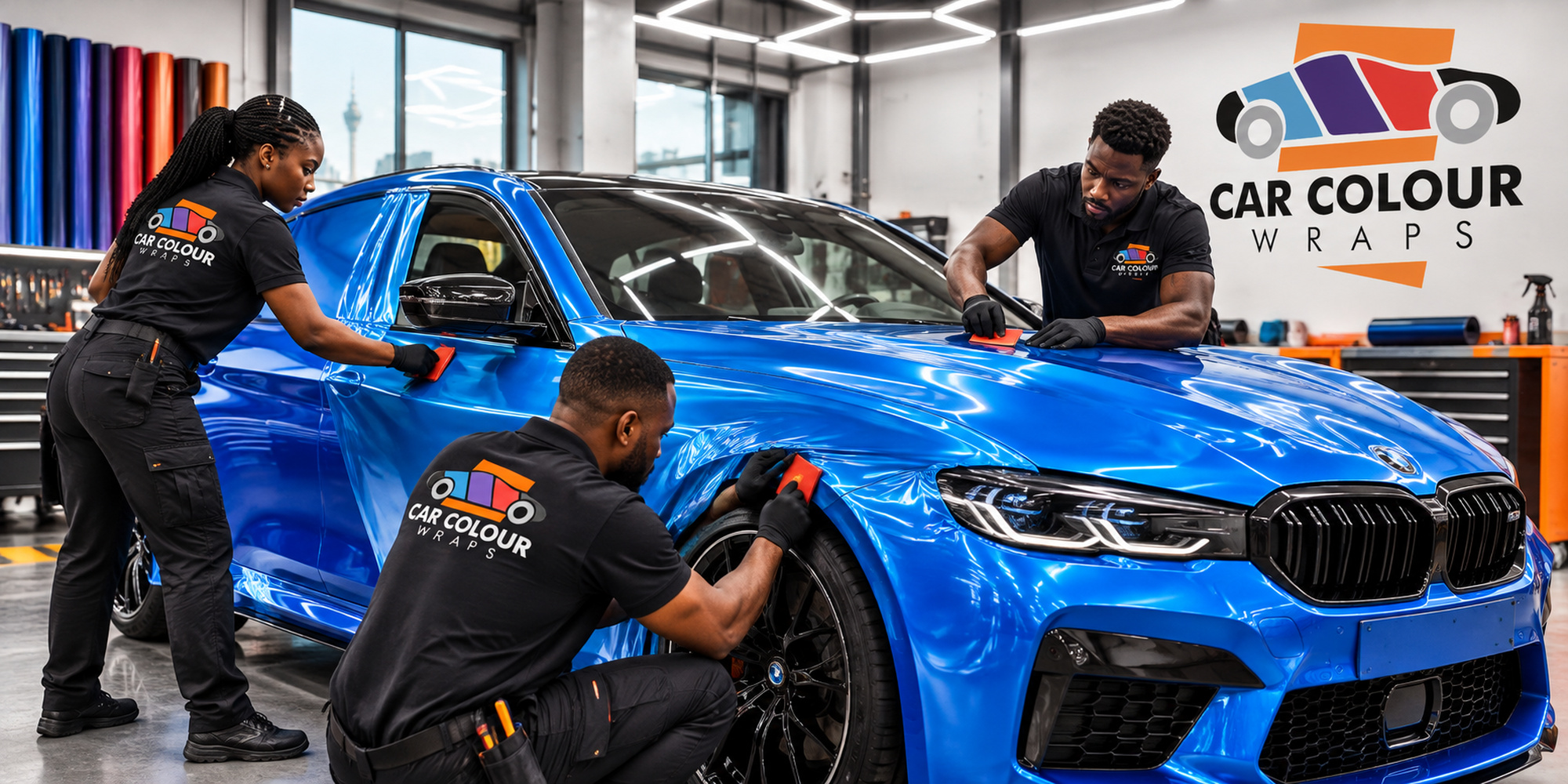

A custom printed wrap uses digitally printed vinyl, so almost any design can go on a vehicle: patterns, gradients, illustrations, camouflage, livery-style designs or photographic images. It is different from a colour change wrap, which uses film that is already coloured.
It suits owners who want a one-off look, show and event vehicles, and anyone whose idea cannot be achieved with a stock colour. For business branding, see our vehicle branding services.
About this service
Every printed wrap starts with artwork. The design must be created at the correct size for your exact vehicle, with allowances for door gaps, handles, curves and areas where the film will be trimmed. Text or key details should not fall across a door gap or deep recess. You can supply your own print-ready artwork or ask us about design and artwork support.
Once the design is approved, it is printed onto wrap film and then covered with a clear laminate. The laminate protects the print from minor abrasion and UV fading and sets the final finish, usually gloss, satin or matte. Printed film needs time after printing before it can be laminated and installed, which is part of the overall timing.
Colours on screen and in print are never identical, because screens emit light and print reflects it. For colour-critical work, we can discuss a printed sample before the full job. Repairs to a printed wrap need the relevant section reprinted, so keeping the final artwork file is important.
Suitable vehicles and common uses
- Personal vehicles with a unique design or pattern
- Show, event and motorsport-style vehicles
- Camouflage or patterned wraps on bakkies and 4x4s
- Gradient or fade designs on sports cars
- Partial printed panels combined with a colour change wrap
- Promotional vehicles needing a one-off look
Available options
- Full printed wrap or printed panels only
- Gloss, satin or matte laminate, subject to material availability
- Customer-supplied print-ready artwork
- Design and artwork support for your idea
- Printed graphics combined with solid colour change film
- Perforated window graphics on rear and side rear windows, where legally appropriate
Options depend on the material available at the time of your project and on your vehicle. We confirm exactly what is possible in your quotation.
Why choose it
- Almost unlimited design freedom
- Effects such as gradients and images that solid films cannot achieve
- Laminate adds a protective layer over the print
- Individual panels can be reprinted if damaged
- Removable, with original paint underneath
Things to consider
- Artwork must be prepared accurately for the specific vehicle
- Screen colours and printed colours will differ
- Repairs require reprinting, which needs the original artwork file
- Images that cross door gaps or deep recesses can distort
- Wraps are not applied to the front windscreen or front side windows
Preparation and installation process
- Brief and vehicle measuring. We discuss your idea and confirm the exact vehicle model so artwork is built to the correct dimensions.
- Artwork and proofing. Your artwork is prepared or checked, and you approve a digital proof showing how it sits on the vehicle.
- Print and laminate. The design is printed onto wrap film, allowed to settle, then laminated in your chosen finish.
- Paint check and preparation. We inspect the paint, then clean and degrease the vehicle, removing parts where needed.
- Panel-by-panel installation. Printed panels are aligned across gaps and body lines so the design flows correctly.
- Final review. We check alignment and edges with you and explain care for laminated print.
What affects the price
- Design and artwork time, if you need support
- Area of print and laminate required
- Vehicle size and complexity
- Laminate finish chosen
- Full wrap or printed panels only
- Number of revisions to artwork
Every vehicle is different, so we quote each job individually. Your final quotation depends on the vehicle, the material, how much of the vehicle is covered, any artwork, and the condition of the paint once we have assessed it.
Turnaround
Printed wraps involve more stages than a solid colour change: artwork preparation, proof approval, printing, laminating and installation. Timing depends on how quickly artwork is finalised, the size of the job and the vehicle’s complexity. We confirm the timing with your quote.
Care and maintenance
- Hand wash with pH-neutral shampoo and a soft mitt
- Follow care rules for your laminate: no wax or polish on matte or satin laminate
- Avoid harsh solvents that could cloud the laminate
- Keep pressure washers away from edges
- Keep a copy of your final artwork for future repairs
Frequently asked questions
Can I supply my own design?
Yes, as long as it is print-ready and built to your vehicleu2019s dimensions. We check files before printing and let you know if changes are needed.
Why does my design look different printed?
Screens show colour with light, while print uses inks on film. Some bright screen colours cannot be matched exactly. A printed sample helps for colour-critical work.
What does the laminate do?
The laminate is a clear layer over the print. It protects the ink from minor abrasion and UV fading and sets the gloss, satin or matte finish.
Can you print a photo onto my car?
Yes, if the image has enough resolution for its printed size. Low-resolution images look blurry when enlarged, so we check this first.
Can you print on the windows?
We do not wrap the front windscreen or front side windows. Perforated graphics can go on rear and side rear windows where legally appropriate, so check the regulations first.
Areas we serve
Customers bring their vehicles to our workshop in Rivonia, Sandton from across Gauteng. All installations take place at the workshop.